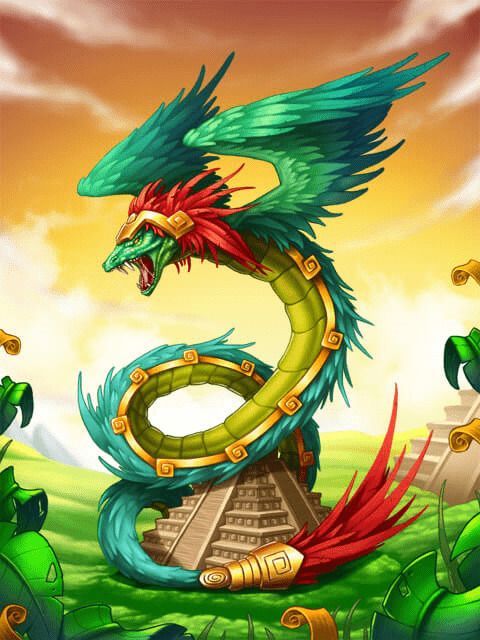
These are several names of the Mayan deity known as Kulkulkaan. Among the various peoples of Mesoamerica, this god is known by many names and characteristics, but he is always shown as part serpent with colorful feathers. The name Kulkulkaan comes from the Yucatec form of the name, where kuk meaning feather, the adjective suffix -ul, and the word kan meaning serpent, combine to make the name translate to Feathered Serpent.
Kulkulkaan is a bringer of rain and winds. He controlled storms and granted life. Alongside other gods, he assisted in the creation and destruction of the worlds and humans. He brought writing, knowledge, and arts to the people of the Yucatan.
A famous story tells of the god being a boy born a serpent, whose sister cares for him in a cave as he grows up. Eventually, he becomes too big for the cave, so he must leave for the sea. After flying into the sea and causing earthquakes, the serpent god decides to tell his sister he is safe each year by causing earthquakes. This story relates Kulkulkaan’s connection to humanity, water, earth, caves, and snakes. Snakes are seen as both givers of life and bringers of death in Mayan culture; caves, similarly, are seen as portals to and from the underworld.
The city of Chichen Itza on the Yucatan Peninsula was the home of Kulkulkaan’s massive worship. The cult that resided in this ancient city facilitated communication between the various Mesoamerican people, peaceful trade, and information gathering. Kulkulkaan is seen in several statues across the city, especially on the central temple of El Castillo. These statues depict a man’s face coming out of a serpent’s mouth, reflecting the god’s dual aspects of both man and beast, god and mortal, life and death.
El Castillo plays a unique role during the spring and fall equinoxes. As the sun’s angle in the sky changes, the shadows cast by the stairs show a serpent crawling up and down the stones from the top to the bottom of the temple structure.
A man named Kulkulkaan resided in Chichen Itza, yet it is unknown precisely if he was a ruler or priest. He appeared around the 10th century, yet some of his stories are notably older. Because of the same names, myths about the god and the man have become blurred and confused to the modern people, especially because the man has been depicted as a Vision Serpent and some stories claim he wasn’t human at all.
Under many names known by several people, Kulkulkaan fostered culture, knowledge, cities, weather, and people. People can watch him slither up and down his famous temple in an ancient city every year, witnessing the impact of an old god.
See the following article for more information about the various gods associated with Kulkulkaan:
Kulkulkaan in World History
The Rainbow Serpent: Colorful and Wise
Similar to the Mayan Kulkulkaan, the Rainbow Serpent of the Aboriginal mythology of Australia is known by various names across the continent. The commonality among the various stories is the colorful scales of the creator deity, its association with water, and its amazing power.
Some of the names of the Rainbow Serpent were Yurlungurr (the Murngin people), Witij (the Galpu clan of the Dhangu people), Kanmare (the Pitapita) Tulloun (the Mitakoodi) and Kooremah (the Mycoolon). There are many, many more names and variations on the Rainbow Serpent features and story, each unique to their own clan and tribe.
During Dreamtime (the creation time of the world according to Aboriginal belief), the Rainbow Serpent came from beneath the earth and created ridges, mountains, and gorges as it rose. This giant snake resides in deep waterholes, thus establishing a connection to the land&rsqo;s most precious resource: water. Because of its association with creation and destruction (because when angered, it kills), the Rainbow Serpent also lends power to fertility myths and coming of age rituals.
Some stories claim the deity causes or stops rain by slithering across the land. It can control all liquids, including blood, thus being associated with the menstrual cycle and healing. When the Rainbow Serpent is enraged, it summons thunder, lightning, storms, and strong winds.
While not possessing a consistent gender, the Rainbow Serpent is always depicted as a snake. It is a deity of cosmic power, capable of birthing the world and destroying it.
This figure has many variations across the peoples of Australia, showing that differences do not separate people, but link them through time, space, and hope.
Dragons: From Ancient Stories to Modern Movies
Throughout the millennia of human history, people have been fascinated by dragons. From the ancient Mesopotamian Tiamat in the cradle of civilization, east to the great progenitors of Asian culture and people, and west to the fearsome beasts of caves and hoarded gold. Humans see dragons everywhere, from old stories to modern movies and TV.
When someone first hears the word “dragon” in today’s world, one of their first thoughts is the Game of Thrones show or House of the Dragon prequel show. These show a type of dragon called a wyvern, differentiated from other dragons by its two hind legs and front legs combined with their wings. The shows, based on the A Song of Ice and Fire book series by George R.R. Martin, host numerous dragons. Some of them are: Balerion (The Black Dread, ridden by Aegon I Targaryan), Caraxes (The Blood Wyrm, ridden by Daemon Targaryen), Drogon (largest of Daenerys Targaryen’s dragon trio), and Meleys (The Red Queen, ridden by Rhaenys Targaryen).
Another popular book series featuring dragons is the Inheritance Cycle by Christopher Paolini. The main character in the series, Eragon, bonds to the blue Saphira in the first book, upon the cover of which is her head and neck. At the end of the second book, Eragon fights Murtagh and his newly-hatched red dragon Thorn, who is the fierce-looking dragon on the cover. The third book shows an older gold-yellow dragon, who is revealed to be the dragon Glaedr, whose rider Oromis was the last dragon rider before Eragon and Saphira. The final book births a new dragon, the green mate of Saphira, Firnen, whose rider is Arya, Eragon’s love interest and friend throughout the series.
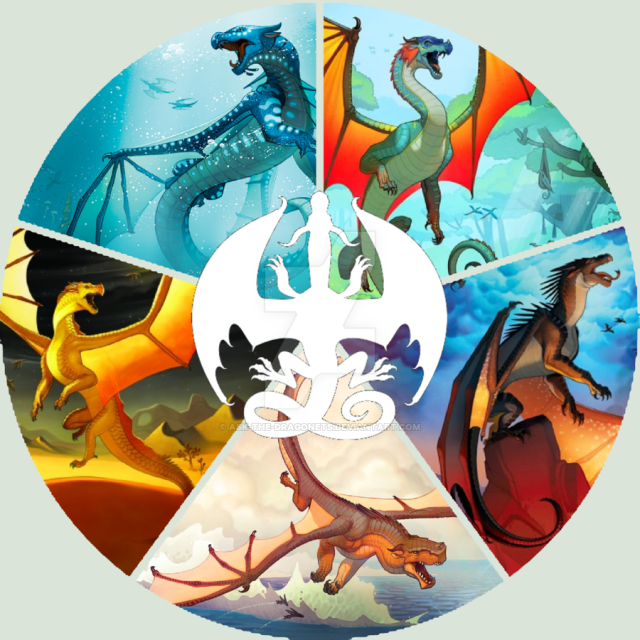
Many book series feature dragons as the main characters. Tui T. Sutherland’s Wings of Fire series is told from a different dragon’s point of view in every book. The books explore the continents of Pyrrhia (in the first and second arc) and Pantala (in the third arc) as dragonets fight to stop wars from raging across their lands. Each dragon is unique, bringing a new insight into the world that is built with every story.
Some of the most popular dragons in movies are featured in the Godzilla franchise’s movies. Dagahra and Desghidorah are two draconic kaiju who fight Mothra, a moth-like kaiju who wishes to protect humanity. Both villainous kaiju monsters are both Western dragon-inspired. Dagahra is a bulky green beast with leathery bat wings, a spiked tail, and four limbs alongside a reptilian face; just like the modern depictions of classic Western dragons, but more buff like he goes to the gym three times a day. Desghidorah, on the other hand, resembles a Greek hydra more than a classical Western dragon, yet it still has bat wings and four legs, and can breathe fire. He is similar to King Ghidorah, another Godzilla villain, except the king only has two legs rather than the classic four.
A trio of movies released in the 2000s have dragons in the title: How to Train Your Dragon. The first dragon met and befriended in the movie trilogy is Toothless, a Night Fury known as the embodiment of lightning and death itself according to the Book of Dragons. The second movie and in between shows reveal more dragons, with the second film focusing on the king of dragons, the Bewilderbeast, a titanic dragon the size of a mountain. The third movie closes with all of Berk’s dragons heading to the titular Hidden World, led by Toothless and his mate the Light Fury. It is revealed at the end of the film that dragons still roam the world, remembering their human friends, but remaining hidden from those who wish to harm the majestic beasts.
These examples and more show how prevalent dragons are in modern media. The above list is small compared to the expanse of draconic characters in novels, tv, and movies across the globe. Dragons are the epitomous creatures humans use for various purposes: as villains, as friends, as pets, as companions, as what humans aspire to be.
Dragons have lasted millenia, long before humans recorded their interactions with and stories of them. They will live past this generation and the next, growing and evolving alongside humans, just as twin souls are meant to.